Friday, 16 May 2014

The Bee Inspector comes calling

Bee Inspectors are a wonderful breed! I have yet to meet one I don't like.

Because we brought in hives from outside the area(in an area with more disease than here) it was important to get the Bee Inspector in asap. The 2 notifiable diseases which are brood diseases(American Foulbrood and European Foulbrood) are usually transmitted by humans and their activities so this would be a prime time for infection of my existing colonies if there was any sickness in the hives. The Bee Inspectors are available as a service of DEFRA-they cost you nothing and it is always advisable to get them in. My experience has always been good. They can often come out to see a problem quicker than you can say G.P! They don't criticise or judge the way you keep your bees and are there purely to check the health of the hive.

Edmund examining the Langstroth
Edmund Thomas has been out to my apiary on a couple of occasions. The notes he makes go onto a database which I can access through Beebase. My GPS location is logged and any observations of the hives that he thinks relevant will go onto that database. This information is important for disease forecasting amongst other things.


The comb is broken where we pulled the roof off. 
 The first thing we noticed was how many bees were in the hive. This was a very strong colony. The bees had taken to constructing comb on the underside of the roof which they had then filled with honey.


 Looking down through the Langstroth frames we can see the frames of the Warre below. At this stage it's not possible to see what they are doing but we hope they are drawing out the wax to form comb.
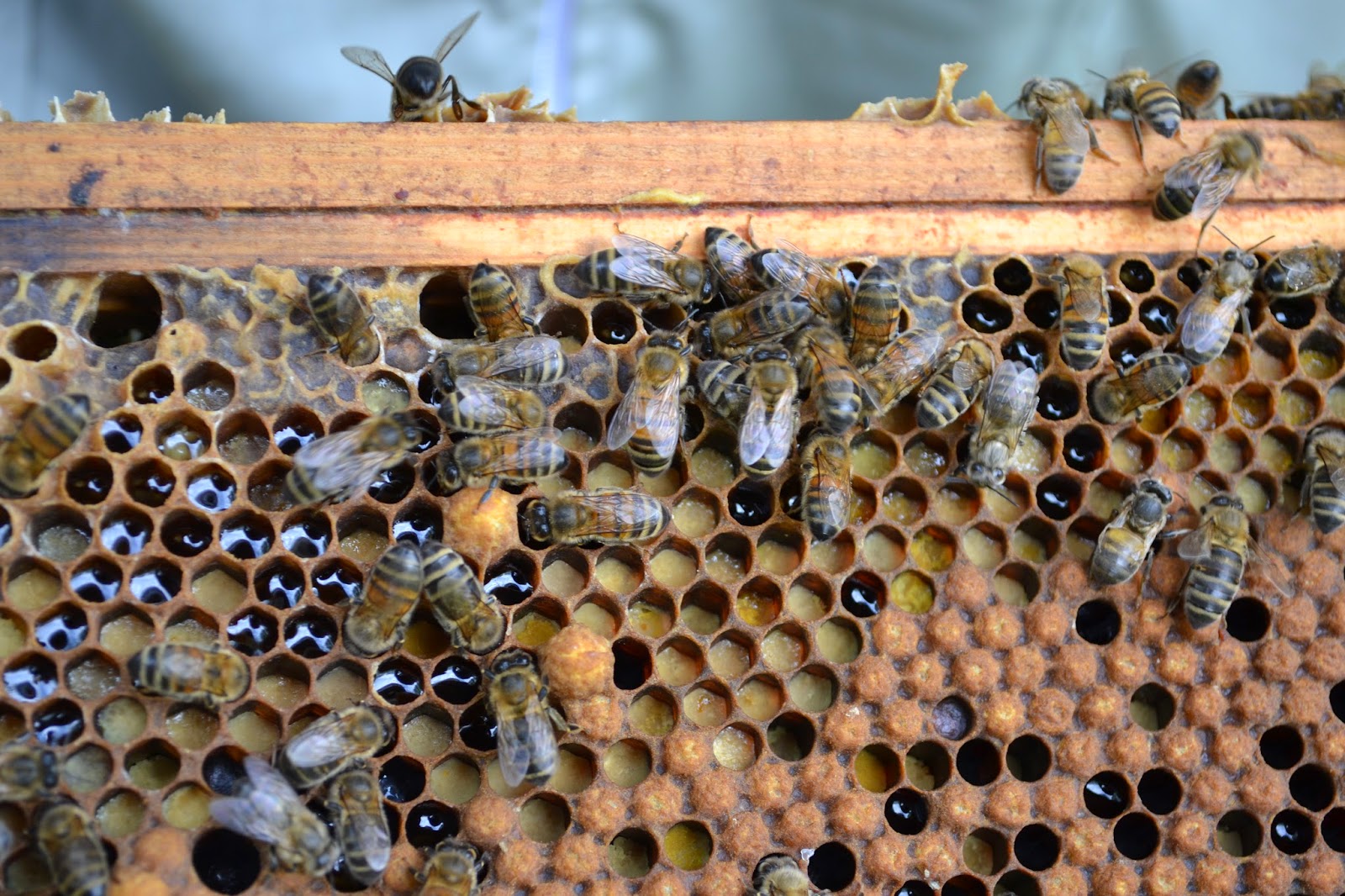
The picture on the right shows a section of a frame with the typical distribution of brood in the centre surrounded by stores-pollen then honey. The wax is dark brown suggesting that this is comb which has been used before and is stained by the moultings of pupae.
Again on the left we see the typical 'biscuit' coloured cappings of the worker brood surrounded by cells of pollen surrounded by cells of nectar waiting to be capped as honey.Note the different colours of pollen from different sources.Below is a link to a very good pollen chart which is laid out in seasons to help identify what the bees are bringing in.


Capped honey looks different to capped brood and weighs a lot more. This is still the dark, re-used comb of the Langstroth.


On the left is one of my own first natural bee keeping frames. Note the brightness of the clean, new wax. On the far right we can see the domed caps of the larger drone(male) larvae and further to the left we see the even, flat cappings of the worker(female) larvae.
The above picture is of another one of my natural bee keeping frames and shows a lovely, consistent pattern of brood in the centre of freshly made wax comb. Clean and hygienic, this sheet of comb has been drawn entirely from a bead of wax along the top bar. 


Wednesday, 7 May 2014

Warre Construction


At last the flat pack Warres have arrived.

The wood for the hives has been locally sourced from sustainable resources within the Brecon Beacons National Park. The favoured wood for hives which score high on outdoor durability and weight is red cedar wood but in its absence we are using larch. This is heavier than the cedar wood but as the hives are of smaller dimensions than other hives we are hoping they are still quite manageable.

Work commences


  1. Armed with a handful of phone pictures, a couple of electric screwdrivers and plenty of enthusiasm we set to work on construction.

2.  Being of questionable carpentry experience I was given the far simpler job of constructing the boxes. All with pre-drilled holes this was an extremely straight-forward procedure.
3.  Somewhat trickier I left the roof to Gareth. Nice and deep to allow for insulation and ventilation.
 We did think it prudent to cover the screw tops with a sealant to stop water getting in.
4. The second box was slightly more challenging as we had to consider the adapter which would fit into it holding the Langstroth hive.
Here we can see how the box literally just sits atop the floor.
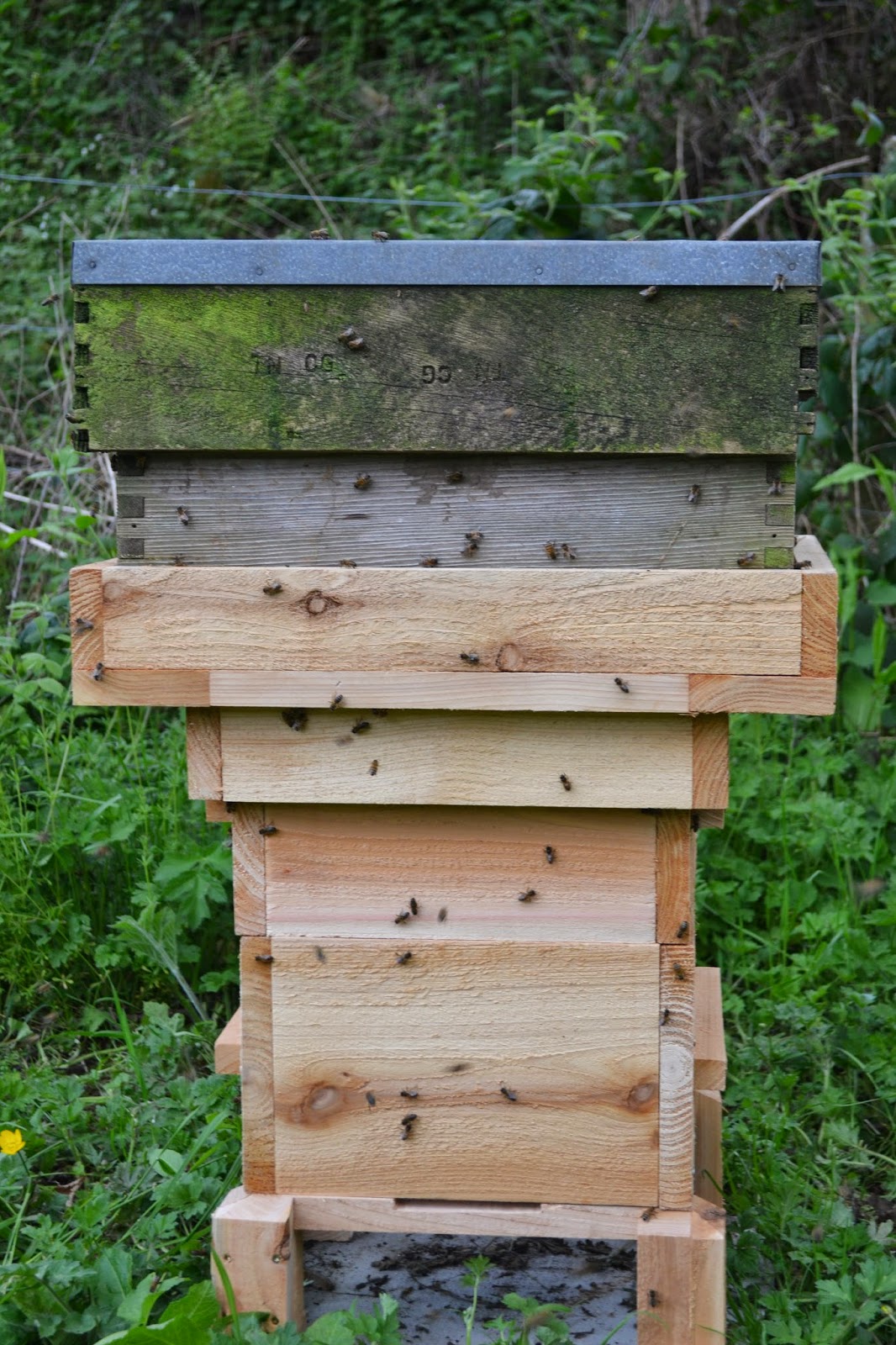
 5. 3 boxes,the floor complete with legs and roof. The doorway is visible on the floor piece.


6.  And looking down from the top the castellations are visible and the mesh of the floor.


7. Each of the tops bars should be primed with a bead of beeswax running down the underside. We'll cover this in a demo for anyone who is unsure of how to do this.
8. All the top bars ready to fit into the castellations
9. We tapped 8 bars into each of the boxes. Some people choose to nail them down but we want them accessible for inspection.


10. We took the whole contraption down to the apiary to set up.

11. First job to move the Langstroth and place the Warre in its place. Then we hefted the Langstroth into the adapter above the 2 Warre boxes leaving the Langstroth  floor outside for the stragglers to find their way in. This wasn't a day too soon as the bees had been clustering on the outside of the old hive and were desperate for space. Hopefully they will be settling into their new home.


Related links:


Tuesday, 6 May 2014

Sam Comfort's Anarchy Apiaries

Thinking of a pet?


Bees as Pets?

I have a dog.
I have a couple of cats.
I have poultry.


I have no licences for any of them and I don't have to register any of them(although it is the responsible thing to notify DEFRA if you have poultry).


I haven't been on a course to learn how to look after them-I observe them and seek professional help if something is wrong.

I haven't dissected any of them.

I haven't taken an exam to learn about any of them.


Maybe it's because bees are so crucial to our lives that they command such rigorous attention?


When I attended a talk on Natural Bee Keeping someone from the audience called out 'so you're keeping them as pets?' To which the answer was 'Yes, I suppose I am......'

What key points do we consider when thinking about getting a pet?
  • Cost
  • Commitment
  • Reward
As an example, my dog(which is from a rescue centre) cost me £100. I had her spayed (over £100). I bought her a nice bed (£30) and had her vaccinated, then I bought her food bowls.On top of that I pay for her food (up to £30 per month, every month) and can't take her on holiday or even in some pubs. She keeps me fit and is good company-for me and the family.

Bottom line-quite expensive, quite a commitment and only benefiting few people.

Let's compare that to bees.....
A Warre hive can be purchased for £120. A colony of bees may set you back £100 or you may be lucky enough to get a swarm. That's it. They fetch their own food and may only need cleaning out once a year. A couple of inspections and maybe a feed if the weather's been poor and some cleaning of equipment before re-use. 

Bottom line-initial outlay but ongoing costs are minimal and if you are lucky there may be some honey to harvest.

Lots of people spend huge amounts of money feeding birds in Winter or putting up nesting boxes or looking after hedgehogs.

Bees as pets? Why not?


As an addendum I would like to add that I am not advocating slipshod management or unhygienic practices and it must always be borne in mind that some bee problems can be on a microscopic level. 


Tuesday, 29 April 2014

Bees Are Here

 The bees have arrived.

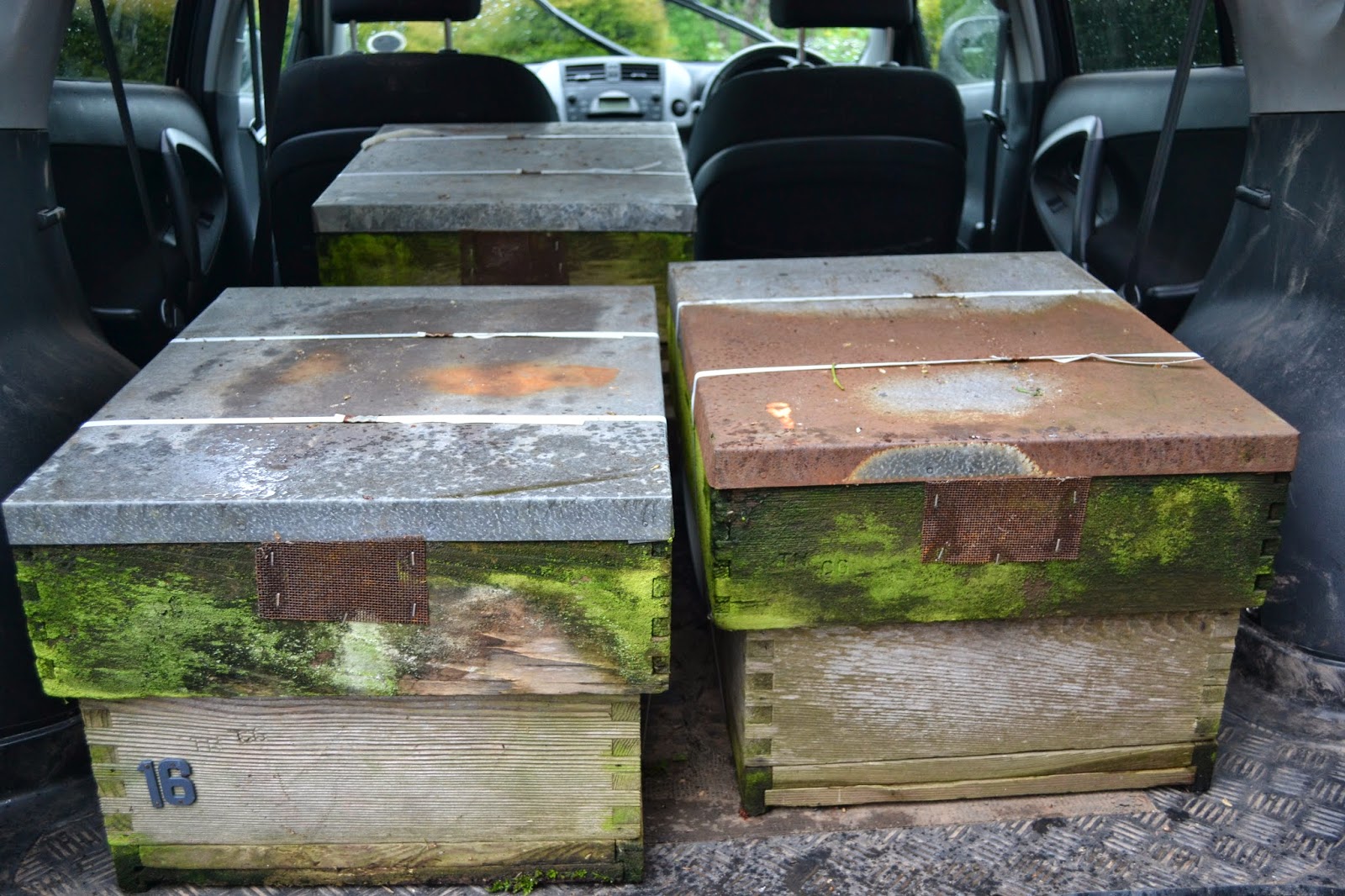
The weather is rough today so what better way to spend the morning than to drive over to Cardiff to pick up our new guests. 3 hours later and we have 3 Langstroth hives with bees 'of no particular pedigree' waiting to be sited. David placed a couple of slabs in the apiary at the weekend so we are good to go. My only reservation being the conflict of sizes. We are hoping to rehouse the bees in Warres which are a good bit smaller so the slabs have been purchased with them in mind rather than the larger Langstroth. Let's hope there's no wobbling.


In pouring rain the hives are sited in line with my existing colonies. The hive is literally buzzing and as I lift the hive against my leg I can feel the heat of the colony through the wood. The gauze is holding well and I shall let them out tomorrow after they have buzzed the worst of their anger out.

Key things to remember when transporting bees: traditionally it is held that you can move bees more than 3 miles or less than 3 feet during their active periods. More than 3 miles guarantees the bees will not enter onto any previously formed flight paths and therefore should not be tempted to return to their old site. Less then 3 feet and they should still be able to locate the scent of their colony. In winter you can move them readily wherever necessary.

Like other creatures, bees need to breathe so a good heavy duty gauze pinned to the doorway should ensure your drive is not interrupted by escapees. Trust me when I say that is not a funny situation!


The bees' new home


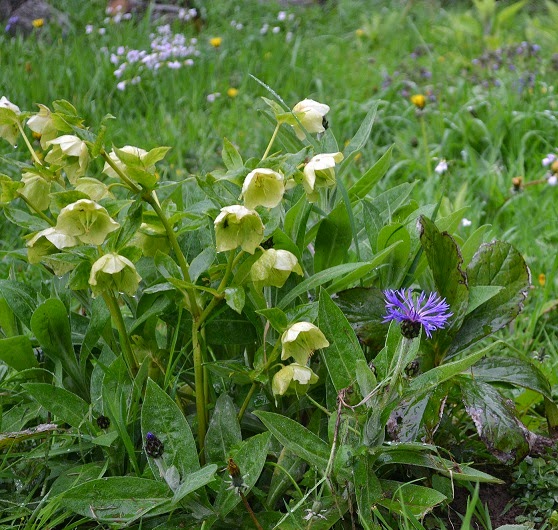
Although not considered as useful to the
 honeybee as the foetida
the Hellebore nudiflora offers early pollen.
We live near woods so a large part of the bees' forage will be willow and  hazel. In the apiary we have a selection of (not always wild) flowers which include Hellebores , Knapweed, Cuckoo Flower, Lungwort, Primroses and the ever present Dandelion.
The new arrivals waiting to be released.


As a general rule of thumb, flowers with many whorls of petals are likely to have sacrificed their nectaries for flower power.
 Floribundas are therefore less attractive to honey bees.


Among the wild flowers which have seeded themselves successfully can be found some cultivated garden flowers. Pot marigolds and wallflowers grow side by side with the lesser celandines and dandelions.


For more information on good plants to attract wildlife to your garden try these sites:
 http://www.rhs.org.uk/science/pdf/conservation-and-biodiversity/wildlife/rhs_pollinators_plantlist
http://www.buzzaboutbees.net/wildflowers-and-natives.html


13th May 2014
The second hive is constructed and positioned with the adapter and Langstroth. As is ever the case the bees have found all the nooks and crevices and I suspect are not using the intended doorway as much as they should be.


Bees in action..

Once their new Warre Hives are built we can transfer them from these Langstroth Hives and start to watch their progress, naturally!
For more information on natural bee keeping and how you can get involved email beecaring2@gmail.com